
6 Reasons Why Classical Guitar Sight Reading Is So Difficult (And What You Can Do About It)
What Makes Classical Guitar Sight Reading So Challenging?
Ask any classical guitarist what their weakest skill is, and the answer is almost always the same: sight reading. It doesn't matter whether they've been playing for two years or twenty — classical guitar sight reading has a reputation for being uniquely, stubbornly difficult. And unlike most technical challenges on the instrument, it tends not to improve on its own.
If you're based in Wimbledon, South West London, or the surrounding area and you've been struggling with sight reading, or you're a parent watching your child avoid the sheet music in front of them - this article will explain exactly why it's so hard, and what structured lessons can do to fix it.
The Fretboard Has No Fixed Map
On a piano, every note has exactly one location. On the classical guitar, a single pitch can be found in up to five or six different places across the fretboard. When you see a note on the page, you don't just identify it — you have to decide where to play it based on context, fingering efficiency, position, and tone. That decision-making process, happening in real time, is one of the core reasons classical guitar sight reading is so much harder than sight reading on most other instruments.
This is a problem that improves dramatically with systematic fretboard training — the kind that a good teacher will embed into lessons from early on, rather than leaving students to figure out on their own.
Multiple Voices, One Instrument
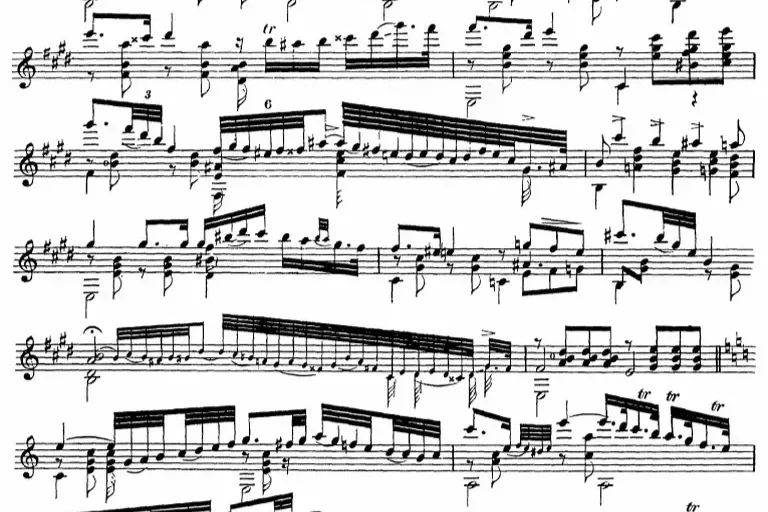
Classical guitar is a polyphonic instrument. A single piece of music might ask your right hand to simultaneously carry a melody, a bass line, and an inner voice — all notated on the same staff, with simultaneous alternate rhythms with stems going in different directions. Reading those layers in real time, while assigning individual fingers to each, is a significant cognitive task.
This is one area where having an experienced teacher in the room makes an enormous difference. A good teacher will show you how to break the page down — how to prioritise the melody, how to keep the bass grounded, and how to gradually build up to reading all voices together.
Position Playing Requires Reading Ahead
Classical guitar is played in "positions," where your first finger anchors to a particular fret and the surrounding fingers cover adjacent frets. Shifting between positions mid-piece — while reading ahead to anticipate the next shift — is a skill that takes months of deliberate practice to develop. Without it, sight reading stalls every time the music moves up or down the neck.
Fingering Decisions Don't Happen Automatically
On many instruments, the "mechanical" side of playing becomes largely automatic after enough practice. On classical guitar, the right hand must constantly assign specific fingers (p, i, m, a) to specific strings, often planning several beats ahead to avoid awkward patterns. During sight reading, this competes directly with the task of decoding notes — and without proper training, one or both will suffer.
Notation Is Unusually Complex
Classical guitar is a transposing instrument — it sounds an octave lower than written. On top of that, scores often include string indicators (circled numbers), position markers (Roman numerals), and fingering for both hands all at once. Parsing all of this in real time is a genuine skill in itself, and one that benefits enormously from guided explanation rather than trial and error.
Sight Reading Is Rarely Taught Systematically
Perhaps the biggest reason so many guitarists struggle is cultural: classical guitar pedagogy has historically emphasised learning pieces by heart — often from recordings — rather than developing reading skills. Many students go years without anyone pointing out that sight reading is a trainable skill with a clear developmental path. By the time they realise the gap, the habit of avoiding the page is already well established.
The Good News: It Responds Quickly to the Right Approach
Unlike some aspects of classical guitar technique that take years to shift, sight reading can improve noticeably within a few months when approached correctly. The key principles are straightforward:
Daily short sessions beat occasional long ones. Even ten minutes of focused reading every day builds fluency faster than sporadic marathon practice.
Always read below your technical level. Sight reading practice should use music that's significantly easier than your current repertoire, so your brain can focus on reading rather than execution. I always encourage students to pick exercises that are about 2-3 grades easier than their current pieces.
Never stop. The most important rule of sight reading: keep the pulse going, accept imperfect notes, and never go back. Stopping to correct mistakes trains hesitation; pressing forward trains fluency. It is far better to make fretting errors, but keep going than to make fretting errors, but repeat them 10 times!
Use a graded system. The ABRSM sight reading scales (which run from Grade 1 through Grade 8) offer a structured, progressive path that takes the guesswork out of what to read next. Working through these systematically, with a teacher who can give immediate feedback, is one of the most reliable ways to improve.
Why This Matters for Lessons in Wimbledon
Whether you're an adult learner picking up the guitar for the first time, a student working towards ABRSM exams, or a parent looking for lessons for your child, sight reading is one of the most valuable skills you can develop, and one of the most commonly neglected.
Good classical guitar lessons in Wimbledon should include sight reading as a regular, structured component, not an afterthought. Over time, strong reading skills unlock the entire repertoire of classical guitar music, remove the dependence on recordings and tabs, and make ensemble playing, exam preparation, and continued learning far more accessible.
If you or your child has been struggling to make progress with sight reading, or if you've never had it formally addressed in lessons, that's a very common starting point, and one that's entirely fixable with the right guidance.
Classical Guitar Lessons in Wimbledon — In Person and Online
I offer classical guitar lessons from my home studio in Wimbledon Village, as well as online sessions for students across South West London and beyond. Lessons cover technique, repertoire, music theory, and sight reading in a structured, progressive way: tailored to each student's age, goals, and current level.
Whether you're a complete beginner, an adult returning to the instrument, a child preparing for their first ABRSM exam, or an experienced player with specific gaps to address, there's a lesson format to suit you.